Nauticus Robotics develops autonomous underwater vehicles and robotic systems designed for sustainable subsea operations, utilizing mechatronics and AI-driven control software. Their technology reduces the need for large vessels and divers, enhancing safety and efficiency while minimizing environmental impact in industries such as renewable energy and aquaculture.
Find Investable Startups and Competitors
Search thousands of startups using natural language—just describe what you're looking for
Underwater Robot Startups
50 companies matched by StartupSeeker’s semantic search. Average reported funding: $5.4M.
Snapshot from
Nautica Technologies provides autonomous underwater robots that clean ship hulls in‑service, mechanically removing biofouling without toxic paints. The system continuously reduces drag, fuel consumption and emissions while collecting waste for responsible disposal, and offers real‑time performance monitoring via a cloud dashboard.
Neptune Robotics manufactures AI-powered underwater drones that perform robotic hull cleaning and inspection using cavitational technology to maintain vessel efficiency. Their services help maritime enterprises reduce fuel consumption and carbon emissions, contributing to sustainability goals in the industry.
Hydromea develops wireless underwater robotics and communication technologies to enhance the inspection and monitoring of submerged assets. By eliminating physical tethering, their solutions reduce operational costs and carbon emissions while enabling real-time data acquisition and analysis for the growing ocean economy.
BeeX provides Autonomous Robotics-as-a-Service (ARaaS) using in-house designed hover-capable Autonomous Underwater Vehicles (AUVs) for underwater inspections. This technology reduces operational costs by up to 50% and CO2 emissions by 95%, while delivering actionable data 2-14 times faster than traditional methods.
Vatn Systems develops affordable autonomous underwater vehicles (AUVs) that operate in cooperative swarms, utilizing advanced navigation software for effective performance in GPS-denied environments. These AUVs enable rapid deployment and execution of complex underwater missions while minimizing hardware costs through a modular design tailored to specific operational requirements.
Albacore Inc. builds mass‑producible long‑range drone submarines using commercial off‑the‑shelf components, allowing high‑volume manufacturing with minimal specialized tooling. Their submarines feature advanced energy storage and propulsion for up to 1,000 nautical miles of transit—about ten times the range of comparable platforms—and embed autonomous analytics and navigation software for reliable unmanned missions. Designed for rapid deployment, they can be launched from boats, piers, or shorelines by small teams, providing scalable undersea capabilities for military operators.
Bedrock Ocean Exploration designs, builds, and operates Autonomous Underwater Vehicles (AUVs) optimized for rapid, fleet-based geophysical surveying. The company provides high-resolution seafloor data that adheres to stringent IHO special order standards for industries like offshore wind and maritime security. This autonomous approach delivers lower-cost, faster data acquisition compared to traditional marine survey methods.
Planys Technologies offers end‑to‑end underwater inspection services for critical infrastructure such as dams, bridges, ports, and refinery assets. Using indigenously developed ROVs, AUVs, crawler systems, and IoUT sensors, the company provides high‑definition video, live streaming, and advanced non‑destructive testing, with AI‑driven analytics and digital dashboards delivering actionable, data‑driven reports without requiring shutdowns.
The startup offers a wind and solar-powered autonomous underwater and surface vehicle (AUSV) designed for long-range ocean missions. This technology enables persistent data collection and monitoring in marine environments, addressing the need for sustainable and efficient ocean exploration.
Dive Technologies designs Autonomous Underwater Vehicles (AUVs) equipped with advanced navigation systems for precise underwater exploration and data collection. These AUVs operate effectively in hazardous environments, eliminating the risks associated with human divers while providing reliable data acquisition.
Remora Robotics develops a fully autonomous submarine robot that cleans and inspects fish farming pens while collecting environmental data. This technology addresses biofouling, which negatively impacts fish health and operational efficiency, by enhancing water flow and reducing the need for harmful antifouling treatments.
Seaber builds compact, modular autonomous underwater vehicles—Yuco and Marvel—that can be launched from vessels or shore bases to perform predefined, crew‑less survey missions. The platforms accept interchangeable sensor payloads (sonar, CTD, eDNA, imaging, etc.) and are managed through the SEAPLAN software, which handles mission planning, real‑time navigation, telemetry, and post‑mission data processing, enabling marine researchers, environmental agencies, and offshore energy operators to collect high‑resolution underwater data more cost‑effectively and consistently.
Hullbot manufactures autonomous robots that perform routine underwater cleaning of vessel hulls, propellers, and niche areas using gentle brushes tailored for all coatings. This proactive cleaning service prevents biofouling buildup, reducing drag and fuel consumption, which enhances fleet performance and lowers operational costs.
This company provides an autonomous, AI-guided underwater robot system for ship hull cleaning and inspection while vessels are in transit. The technology maintains optimal hydrodynamic performance by preventing slime accumulation without requiring costly port downtime. Their solution offers efficient, low-maintenance operation that protects anti-fouling coatings and streamlines fleet management.
Jaia Robotics develops the JaiaBot system, offering high-speed, affordable aquatic drones for data collection. These modular, ultraportable vehicles can be deployed in coordinated pods to rapidly survey wide areas with minimal resources. The system provides cost-effective solutions for diverse sectors including environmental monitoring, aquaculture, and offshore renewables.
Tethys Robotics develops compact underwater drones designed for high-resolution inspections in challenging marine environments, specifically targeting offshore oil and gas, offshore wind, and search and rescue operations. These drones enhance safety for professional divers and minimize environmental impact by enabling efficient and reliable underwater assessments.
Beam develops AI-powered autonomous underwater vehicles and robotic ships to enhance the efficiency of offshore wind farm operations. Their technology addresses the challenges of subsea inspections, maintenance, and decommissioning, significantly reducing operational costs and timelines.
At Depth Solutions provides end‑to‑end subsea robotics for offshore operators, offering the legacy M5 manipulator and fully custom‑built remotely operated vehicles (ROVs). Leveraging in‑house manufacturing in Batam, Indonesia, the company delivers robust, cost‑effective hardware and complete lifecycle support—from design and fabrication to testing, installation, and maintenance—enabling clients to perform inspection, intervention, and data‑collection tasks at depth without developing their own robotics.
Gander Robotics offers the Autonomous Rescue Swimmer (ARS), a hand‑throwable underwater drone that autonomously locates and assists man‑overboard victims using sonar and AI detection. Designed for naval, Coast Guard, and commercial maritime operators, the ARS integrates with existing SAR protocols without additional hardware.
The startup develops subsea robotic systems that utilize visual positioning technologies and homing vehicles to transfer power and data to deep-sea infrastructures. This technology enhances the efficiency of underwater inspections and supports light intervention tasks, enabling ocean-based businesses to reduce operational costs.
Nido develops and manufactures cost-effective underwater robots designed for various applications in the underwater sector, utilizing advanced robotics and sensor technologies. These robots enhance operational efficiency and data collection in challenging underwater environments, addressing the need for reliable and affordable solutions in marine exploration and monitoring.
McMaster RoboSub designs and builds autonomous underwater vehicles that combine mechanical, electrical, and software engineering for research and competition. Their custom propulsion, navigation, and sensing systems enable precise underwater maneuvering and data collection, providing advanced robotics solutions for academic projects and industry sponsors.
Nereus Dynamics provides an autonomous hybrid aerial‑underwater vehicle that launches from a self‑servicing dock, conducts flight‑based reconnaissance, and transitions to submerged operation within seconds for continuous ISR and inspection. The platform streams high‑resolution optical, LiDAR, and sonar data in real time and returns to the dock for automatic charging, cleaning and sensor recalibration, enabling rapid, repeatable missions for naval, offshore and research users.
Blueye develops and sells underwater drones equipped with advanced remote-operated vehicle (ROV) technology for professional inspections and data collection. Their drones enhance safety and efficiency in underwater operations by minimizing the need for divers in hazardous environments while providing real-time visual feedback and autonomous mission planning capabilities.
Blue Robotics designs and sells affordable underwater robotics hardware, including the BlueROV2 ROV, surface vessels, thrusters, and sonar systems. Their open‑source hardware and software enable hobbyists, researchers, and professionals to customize and expand marine vehicles, supported by extensive documentation and an active community of subsea explorers.
Blueye Robotics provides professional underwater ROVs that offer accessible and reliable subsea data acquisition. Their user-friendly systems enable direct visual insight and mission planning for efficient underwater inspections, research, and operations.
Coratia Technologies develops robotic systems for Autonomous Underwater Vehicles (AUVs) and Remotely Operated Vehicles (ROVs) to facilitate deep-sea data collection and inspection. Their technology enhances operational efficiency and safety in challenging marine environments, addressing the difficulties of underwater exploration.
The startup develops scientific and technical instrumentation that integrates electromagnetic detection, navigation, and characterization systems with high-sensitivity electronics and algorithms for subsea and industrial robotics. This technology enables precise local mapping of environments, facilitating obstacle avoidance, wall tracking, and docking in complex underwater and industrial settings.
HonuWorx develops autonomous, all-electric subsea robotics to replace traditional surface vessel operations offshore. Their uncrewed inspection and intervention systems utilize cloud-edge communication to reduce the cost and carbon footprint of subsea maintenance. This technology provides enhanced access and control for marine robotic applications.
Fleet Robotics deploys autonomous, submersible robots for continuous, onboard hull cleaning and inspection of maritime vessels. These robots mitigate biofouling and gather extensive data on coating integrity and submerged infrastructure status. This service transforms routine maintenance into a consistent source of operational performance insights for shipping operations.
SeaDrone utilizes advanced underwater drone technology to conduct subsea lifecycle infrastructure inspections. By automating these inspections, the company significantly reduces operational costs and enhances the accuracy of data collection for asset management.
The startup develops a user-friendly, portable autonomous underwater vehicle equipped with artificial intelligence and simultaneous localization and mapping technology. This solution enables precise ocean exploration and underwater operations, addressing the challenges of efficiency and accuracy in marine tasks.
Ambient Intelligence Technology manufactures underwater drones equipped with advanced imaging and data collection capabilities for marine inspections. Their services provide efficient and reliable underwater inspection solutions, addressing the need for accurate assessments in challenging aquatic environments.
ELWAVE manufactures electromagnetic detection systems specifically designed for underwater and industrial robotics. Their technology enhances the precision of object detection and navigation in challenging environments, improving operational safety and efficiency.
Vantage offers an autonomous, deploy‑anywhere micro‑AUV that provides enterprise‑grade underwater capabilities at a fraction of traditional costs.
The company provides autonomous unmanned vessels equipped with UAVs, UUVs, and ROVs for underwater structural inspection, hydrographic surveying, and hazardous mine detection, supporting commercial and military projects.
Orpheus Ocean designs, builds, and operates autonomous underwater vehicles (AUVs) to provide flexible and cost-effective access to deep-sea environments. Their agile AUVs offer multiple operational modes for comprehensive seafloor data collection and monitoring. This capability supports scalable data acquisition for marine resources, offshore infrastructure, and subsea defense sectors.
InX Tech develops long-endurance, zero-emission Autonomous Underwater Vehicles (AUVs) for seafloor mapping and monitoring. These AUVs capture high-quality seabed data quickly and at a lower operational cost than traditional manned vessels. The company utilizes AI-driven subsea intelligence to automate feature detection, identifying geohazards and infrastructure conditions for the offshore energy sector.
Remora Teknoloji produces Neta Pro, an unmanned underwater robot that cleans ship, yacht and boat hulls without dry‑docking. The robot uses a patented brush, high‑speed vacuum and composite body to collect debris while providing real‑time video monitoring and remote control through a mobile app. Revenue is generated from direct robot sales and service contracts for maintenance and software updates.
Greensea IQ develops intelligent ocean solutions by integrating robotics and software for persistent, efficient, and safe subsea operations. The company offers integrated robotic systems and Robotics as a Service (RaaS) tailored for defense, scientific research, and maritime applications like hull maintenance. Their technology extends operational reach underwater to support critical missions across various ocean domains.
Greensea IQ provides autonomous marine robotics for hull cleaning, seabed surveying, and defense missions, leveraging its portable, non‑magnetic EverClean robots to clean vessel hulls in water without a pilot. The company sells hardware, offers service contracts, and licenses its open‑architecture OPENSEA software platform, delivering reduced biofouling, fuel consumption, and carbon emissions for commercial and military vessels.
Anemo Robotics develops underwater cameras and AI fish detection software to monitor marine biodiversity around offshore structures, providing accurate assessments of species and ecosystem changes over time. This technology enables energy companies to meet regulatory requirements and demonstrate their commitment to sustainable development in the context of wind farm operations.
The startup develops unmanned aerial systems and marine robotic technologies for underwater exploration and data collection, enabling high-definition video, imaging, and environmental monitoring. These systems provide essential insights for defense, aquaculture, and environmental sectors, facilitating effective subsea inspections and data gathering.
Sfynx Industry provides custom robotic platforms for land and underwater missions, featuring modular chassis with interchangeable payload bays and IP68‑sealed electronics. The systems support low‑latency tele‑operation and autonomous navigation through ROS‑2 middleware, sensor fusion, and AI‑driven path planning, and are delivered as turnkey solutions with integration, training, and maintenance services.
The startup develops a submersible robot that utilizes cavitation cleaning technology to remove biofouling from vessel hulls without the need for dry-docking, chemicals, or diver intervention. This approach helps the shipping industry decrease fuel consumption and operational costs while ensuring compliance with environmental regulations.
Chasing Innovation develops industrial-grade underwater drones equipped with advanced remote-operated vehicle (ROV) technology for underwater exploration and inspection. Their solutions provide reliable data collection for marine research, infrastructure maintenance, and emergency rescue, addressing the challenges of accessing and monitoring underwater environments.
JM Robotics designs and manufactures remotely operated vehicles (ROVs) for demanding underwater inspections in sectors like aquaculture and offshore energy. Their robust ROV systems, coupled with integrated control software and support services, enable efficient and safe subsea assessments.

QYsea develops a range of underwater drones equipped with 4K cameras and advanced multi-tool integration for applications in exploration, aquaculture, and industrial inspections. Their technology enables users to navigate underwater environments with 360° omnidirectional mobility, addressing the need for reliable and high-performance solutions in challenging aquatic conditions.
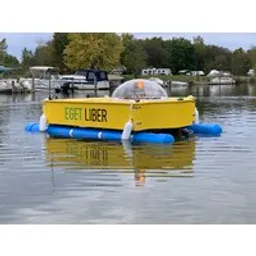
The startup has developed an autonomous, semi-submersible underwater vehicle that utilizes ultraviolet light to eliminate cyanobacterium, commonly known as blue-green algae, in freshwater lakes. This technology is designed to receive command coordinates from an aerial drone that identifies algal blooms through spectral analysis, providing lake associations and property owners with an effective and environmentally safe method to manage harmful algal blooms.